Monday, February 24, 2014

Opera: Making Books Better (Unless That Book Is Little Women)

Much like the television and movie adaptations of now (Gone Girl the movie is happening, guys — not sure how riveting it's going to be if you already know the twist but OKEY DOKEY), back in the day, people would take books and adapt them for other forms of popular entertainment. LIKE OPERA.

I know!

Yes, from early on with Mozart and Beaumarchais's sexy new play Le Mariage de Figaro, to present day with Jake Heggie and Sister Helen Prejean's Dead Man Walking, opera is On Top of It when "It" means giving you that thing you liked already, but now with people singing the whole time instead of just boring words with no music.

What's that? You want to know what popular operas are based on books? WELL THEN.

Il barbiere di Siviglia, Rossini. Because opera likes confusing people, Mozart set the second of Beaumarchais's trilogy to music in 1786, and Rossini set the FIRST to music in 1816. One is clearly better (HINT: it's Barber). While Mozart put a lot of "stuff" and "themes" to think about in his opera, it's also a million hours long and boring as hell. Barber of Seville is a nonstop fun ride of catchy songs and Bugs Bunny-like disguises. Basically, disguised nobleman wants to marry captive pretty girl. Captive pretty girl's old gross guardian wants to marry her. Disguised nobleman ends up marrying captive pretty girl AFTER MANY COMIC SHENANIGANS.

Such as this.

 Lucia di Lammermoor, Donizetti. "Lucia di Lammermoor" is just 'Lucy of Lammermoor," and yeah, it's an Italian opera set in Scotland. OBVIOUSLY. It's also based on the novel The Bride of Lammermoor by Sir Walter Scott, which by most accounts sucks. Some characters were changed a bit for the opera, but overall the story in both versions is very much like Romeo and Juliet, except at the end, Lucia has to marry some guy to make an alliance, the guy she actually loves returns right after she signs the marriage contract (of COURSE), and she then goes crazy and stabs her new husband in their room like 27 times, comes back downstairs, sings her Mad Scene for about 15 minutes and then drops dead.

This is the only scene you'll ever see promoted for this opera

La Traviata, Verdi. OMG IT'S LA TRAVIATA. Which is the best opera ever. Okay, so Traviata is just Moulin Rouge. I wrote a paper on this in high school. But what the opera itself is based on is La dame aux camélias by Alexandre Dumas fils. Not père — fils. So not the guy who wrote The Three Musketeers and The Count of Monte Cristo, but his wispy son who decided to write about falling in love with a courtesan who then coughs herself to death. IT'S SO GREAT. And the book itself is really good, too. MAYBE the best book an opera's based on. Save one. This next one.

Eugene Onegin, Tchaikovsky. The verse novel Eugene Onegin by Pushkin is huge in Russia. No, I don't think you get it — it. is. huge. Pushkin is the Russian Shakespeare, and Onegin is his most famous work. When Tchaikovsky had to adapt some  of the verses for his operatic version, PEOPLE LAUGHED AT HIM FROM THE AUDIENCE. Laughed at his sad attempts at rewriting Pushkin to fit his miserable music! How dare you, sir! How dare you. 

What happens in this is a 16 year old girl is smitten with this guy Onegin, writes him a love letter, he comes to see her and is all dismissive and mansplainy, she is crushed — CRUSHED — and then years letter she's married to a nice old man and is high up in society and he sees her at a party and ah-HAH, this time it is HE who is smitten. But she has honor and stuff and says no, and The End. There's an awesome rhyming translation of this book by Douglas Hofstadter that I was ob-sessed with in high school and you should read it because it's great. Or maybe that's just when you're 16.

Manon, Massenet. This opera kicks ass. It's part of the five act French grand opera tradition, complete with ballet, and what essentially happens is it's the downward spiral of Manon Lescaut from innocent country girl, to fairly innocent mistress, to courtesan, to prostitute, to dead. AND THE MUSIC'S SO GREAT. If you're on Spotify — N'est-ce plus ma main. Find it now (the Beverly Sills version). She's trying to re-seduce her old boyfriend WHO IS NOW A PRIEST, and she obviously succeeds, because that aria is the best. This is all based on the novel Manon Lescaut by Prévost, and you can totally give it a miss, but I'm grateful to it for giving us Manon. I. Love. Manon.

Werther, Massenet. I might be a giant Massenet fan. BUT ONLY BECAUSE HE IS SO GREAT. Okay, this one is based on The Sorrows of Young Werther by Goethe (original title: Die Leiden des jungen Werthers) and is about an emo poet who meets a girl he falls in love with at first sight, but she's engaged to another guy, and in the end Werther shoots himself in the head. There's a whole fun story here about the pronunciation of the opera title, because the original's German, but the opera's in French, so you retain the — you know what, not important, but still fun.

The book's okay, but really focused on philosophy and whatnot, so if you solely want Werther being emo over Charlotte, THE OPERA IS FOR YOU. I got obsessed with it back in the day solely based on the angst radiating from this picture:


There are, of course, others. Verdi wrote operas based on Othello and Macbeth. Thomas wrote a Hamlet, Gounod wrote Faust and Roméo et Juliette, Mark Adamo did Little Women, Puccini did Scènes de la vie do Bohème, Bizet did Prosper Mérimée's Carmen. ET CETERA. But these are the pretty fun ones.

In conclusion, opera is great and you should go see one.

And its fans are kind of fun.

Monday, August 26, 2013

Albinoni’s Vespetta e Pimpinone and Intermezzi, or The Fun Parts Between the Acts

At the beginning of the 18th century, the more spectacle-like tableaux that occurred between the acts of an opera were diminishing in popularity. They were soon replaced by a series of comic scenes called “intermezzi” that broke up the far more serious action of the opera, giving the audience a chance to breathe and to take a break from being overwhelmed by feelings of dramatically-induced catharsis.

So much.

One of the earliest of these intermezzi still in existence is Tomaso Albinoni’s Vespetta e Pimpinone from 1708. The best known is La Serva Padrona, which incorporates some of the same stock characters, but was written far later (1733). Albinoni was taking advantage of the comic possibilities inherent in the master/servant relationship before Pergolesi was but a twinkle in his father’s eye.

In Vespetta, the two characters are a maidservant (Vespetta), “honest, sincere, not ambitious or demanding” and an older man (Pimpinone) who is “not a nobleman, but rich and stupid.” Vespetta’s description should be taken with a particularly large grain of salt, as those are her own words. She enters and immediately asks “Who wants me? I am a servant.” Seeing Pimpinone, she describes him in the above terms, convinces him to hire her as his maid, and in the two successive scenes, manipulates him into proposing, and then walks all over him once they are married, prompting him to conclude the intermezzo with “Whoever has an uncivilized wife will soon repent of it.”

When looking at a piece that uses stock characters, it can be easy to fall into interpreting them as tropes, and certainly that is much of what 18th century audiences expected. They wanted the maid to be clever and the rich man stupid. They knew she would push him around after they were married, and this was hilarious because she was 1) a woman, and 2) lower class. Pimpinone only gets what he deserves in the eyes of the time.

But I hear they're excellent at making sandwiches

Samuel Richardson, well-known author of the mid-18th century, drew huge amounts of criticism for his novel Pamela, in which a maidservant “wins her master’s love” after rejecting his salacious advances for the entirety of the book (unlike Vespetta, Pamela is portrayed as entirely artless and innocent). It was seen as encouraging the young men of the time to marry beneath them. The upper class members of the 18th century opera audience might sympathize with Vespetta as the cunning character, but they would never associate with her.

What has changed in the past 300 years is a shift in the fluidity of class lines. A 21st century audience sees a maid becoming mistress of the house as far less ridiculous than an 18th century audience. When you consider “all passes, art alone endures” in this context, the constant in Vespetta e Pimpinone is the humanity of the characters. Viewers in previous centuries might not have been concerned about Pimpinone’s sexual advances, which are all the more alarming to us now as we are aware of his power both as a man and someone with means. In our current time, we can play her unease as something genuine which can incite worry in the audience, thereby making both characters more fleshed out, as Pimpinone acquires a dangerous side and Vespetta a vulnerable one.

The intermezzo is a little-performed relic of operatic history. As time moved on, comedy began to be put directly into the operas, rendering the respite of an intermezzo unnecessary for audiences. With the ever-shortening attention spans of our current century, one hopes they are due for a revival -- perhaps as an operatic alternative for those not willing to sit through four hours of Wagner.

Monday, April 2, 2012

Diana Damrau Is Really, Really, Really Swell

I'd like to take a moment and take a radical stand by saying Diana Damrau is awesome. I know -- I know, it's not a popular opinion at the moment, but I hold firm to my beliefs and shall not be swayed [note to non-opera people: Diana Damrau is insanely popular].

I saw her at the Met a week and a half ago in L'Elisir, and while I'm not the giantest (real word, shut it) fan of her voice, her acting is superb; she's hilarious; and oh yeah, mega-pretty. BEHOLD:


Also I now mega-ship her onstage with Juan Diego Flórez. Have you SEEN them in Le comte Ory? Oh. Because I haven't. But the DVD is ON ITS WAY and I suspect there will be sexy shenanigans, for I have seen pictures.

Sexiness

Plus de sexiness

Also, in case you were unaware, she's kind of insane in an adorable way. I cite the youtube clip where she's going around Germany on a scooter yelling "Yahoo!" This is what the art form needs, people. This is what it needs.


Sunday, March 20, 2011

Saucy Maids and Why I Hate Them

In most (ok, like three) 18th and early 19th century operas, there is a saucy maid/peasant girl character, and I hate all of them. Susanna, Despina, Zerlina – the only one I can stand is Berta in Barber of Seville, and that’s because she’s old and has a funny song, although I admit I used to hate that too. But it grows on you after a while


Put it on in the background while you read the rest of this.

But no, Berta’s fine. I just hate the young saucy characters. Particularly ladies, because Figaro’s all right. Figaro, Masetto, whoever, they’re all fine because 1) they’re young baritones and I am all for that type being on stage, and 2) they’re usually comic in a way that isn’t essentially “look at me transgressing social boundaries!” (which I guess was funny because the 18th century nobility was pretty much like ‘ha-hah, the class system shall exist forever!’)

He's obviously just wasting her time.


Yes, it’s hilarious that the servant is the one who has to tell the upper class how things work/what they should do in whatever dilemma they find themselves, and I’m sure it was thrilling to watch such social rules being broken in the 18th century, but it is now 2011, we have touchpad computers like in Star Trek, and I am no longer scandalized or even interested in these things.

What lasts? I don’t know. Violetta giving up the only happiness she’s ever going to know for a girl she’s never met. Colline selling his coat to buy medicine for Mimi. Lucia stabbing her husband however many times on their wedding night (wait, no, that’s not good...opera’s messed up). People won’t get annoyed by these things, no matter how many centuries removed they are from their creation. Most characters are at least in some ways going to be a product of their time, and I’m sure there are some redeeming parts to saucy maids, but I don’t care to look for them. Their overriding quality is insolence (that word makes me feel like a 19th century villain), used for comic effect. It’s quite possible I’m the only one who doesn’t find it funny, and in that case, enjoy the clip and ignore the rest of this post. But saucy maids are outdated and dumb.

Wednesday, February 2, 2011

Wherein I Make Fun of Another Opera

Ernani sucks. Let's just get that out of the way right now. It sucks and is dumb. The music's pretty good (Verdi: "Thanks, Alice" Me: "No problem, Verdi") but the plot's insanely, ridiculously stupid. Basically, it's based on a story by Victor Hugo, and they cut out a lot to make it into an opera (as we previously discovered with Così, anytime a character's upset, the action has to pause as they sing about how they're upset. This takes time).

There's a girl. Who's...kind of a princess or something. Three guys are in love with her. Ernani, whom we're supposed to like; Charles V, or "Carlo" or something; and this nobleman dude named Silva, whom we don't like because he's old. Elvira the Princess kind of bounces around from guy to guy with little explanation as to why. She actually loves Ernani. Due to various stupid plot points involving a horn, Ernani has to kill himself at the end.


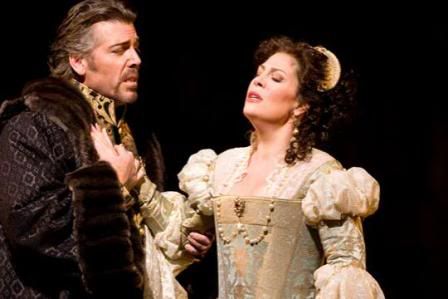
You can tell it's an opera because she looks so soulful and INTENSE

Back when I was newly into opera and generally idealistic about life, I thought Verdi could do no wrong. This was based on my extensive knowledge of his body of work, or rather, the fact that I had listened to a recording of Traviata five billion times (appx) in high school. If he had written something as amazing as La Traviata, I reasoned, surely everything else he did was equally amazing. I thought this despite also knowing that George Lucas made both A New Hope and Attack of the Clones.

If I were actually going to choose a Verdian opera to make his AOTC, I'd probably choose something like Nabucco, but since I've never seen that staged, I'll stick with the Ernani thing, despite it having some beautiful music. Because hey, AOTC has some beautiful music. But I can never unhear that dialogue, and that has made my life sadder.

According to various websites, the following is why Ernani ends up killing himself: he, Silva and the King want to marry Elvira. There's some situation where Silva hides Ernani in a room from Charles V. Then: "Silva challenges Ernani to a duel and is astonished when Ernani reveals that Carlo [Charles V] is also a suitor for Elvira’s hand. The two agree to suspend their quarrel to take vengeance against the king. Once they have done so, Ernani says, his life will be in Silva’s hands. As pledge, Ernani gives Silva a hunting horn: when it is sounded, Ernani will kill himself.

WHAT? WHY?? Why would anyone do that ever?? The moment that happens in the opera, you first say "Well that's an idiotic thing to do," which is swiftly followed by the thought 'That's gonna bite him in the ass.' And indeed it does. Silva RANDOMLY SHOWS UP at the very end, blows the stupid horn, and Ernani's like "Oh, Elvira, even though we just got married and everything looked like it was going to be happy, now I have to kill myself."

Opera's kind of a huge 'suspension of disbelief' setup in the first place. But when you start adding things like "I have to kill myself because I gave that power to this man early on even though it was REALLY STUPID TO DO SO," things get into the 'beyond belief' category. I mean, it's not even tragic then. Instead you're left feeling sorry you wasted three hours listening to characters that were apparently mentally disabled try to navigate a complicated plot. I'm not sure why Verdi didn't ever ask his librettist "Wait...why does he give the guy the horn?" If I had one question to ask him, I'd probably blow it on that, just because this opera pisses me off so much.